President of the Amazigh Committee of the Authenticity and Modernity Party
When a prestigious French newspaper described King Mohammed VI as an “enigma,” it wasn’t just a stylistic choice. It was a reflection of a systematic failure to understand a political institution with historical roots and social foundations that are fundamentally different from familiar European models. What started as a simple, marginal note in Paris was amplified into a series of reports that reduced one of the world’s oldest monarchies to superficialities: a media absence here, a symbolic appearance there, and the conclusion of a “fin de règne” (end of an era).
The core mistake lies not in the small details, but in the perspective itself. The Moroccan monarchy is not merely a political system to be measured by the standards of European republics and monarchies. It is the continuation of a sovereign tradition that is over three thousand years old, originating from ancient Amazigh kingdoms deeply rooted in Moroccan soil and the Amazigh identity. This tradition began with the institution of the Amghar (the wise man, chief elected by consensus), which later evolved into the Agellid (the unifying king, the supreme authority uniting the nation). These entities exercised sovereignty, minted currency, established central administrations, and built organized armies, ultimately leading to the modern monarchy that combines the symbolism of unity with the real capacity to manage strategic transformations.
What outsiders see as an “enigma” is, in reality, a deliberate strategy of stability and modernization. It’s a historical continuity that gives Morocco a unique and stable strength in a turbulent regional environment, turning what is read as a “mystery” into proof of exceptional wisdom and a renewed political continuity.
The Origins of the State — Why Amazigh History is the Answer
The fundamental flaw in Le Monde’s narrative lies in its starting point: it seeks explanations in the fleeting present and measures the monarchy’s strength by its media visibility, ignoring that the essence of this institution lies in the depth of its history. This depth is not limited to documented history alone, but extends to the mythological imagination of the Mediterranean. Centuries before Herodotus wrote his histories, Greek legends placed legendary kings like Atlas and Antaeus in the far west, on the land of Morocco, making it the home of the Gardens of Eternity. In ancient consciousness, Morocco was already a land of power and sovereignty, even if it was initially mythical.
But behind the myth, solid history reveals a more realistic political truth and confirms that the Moroccan monarchy is not an imported concept or a structure imposed by later circumstances. It is the culmination of a local and organic political evolution, deeply rooted in the Amazigh social structure itself.
To understand this, one must go back to the periods before Rome and Carthage. The central idea of power in Morocco began with the institution of the Amghar, the tribal or community leader who was elected by consensus and embodied wisdom and the ability to arbitrate. This model gradually evolved to become the Agellid, the unifying king, whose authority expanded to unite groups of tribes and regions under one banner. Here, the monarchy was not an imposition from above, but a natural response to the need for unity and security, which gave it a unique historical and social legitimacy.
This evolution is not just an anthropological theory, but a historical fact embodied in powerful kingdoms that exercised full sovereignty over Moroccan territory. King Bocchus I is a prominent example; he was not an ordinary tribal leader, but the head of state of the Kingdom of Mauretania. He made Tangier his capital and managed complex diplomacy with the major powers in the region. The organization of the administration, the building of armies, and the management of foreign relations are all evidence of a strong state capable of making strategic decisions and effectively protecting its independence and regional interests.
Later, the cultured king Juba II offered another model of the Amazigh monarchy, where power was blended with culture and civilization. During his reign, the city of Volubilis flourished as a royal residence and a cultural and artistic center, which indicates that these kings were not just rulers, but builders of states and civilizations. The organized cities, minted coins, and central administration are all irrefutable physical proofs of the depth of this sovereign tradition.
This history is not just a relic of the past; it is the living DNA of the Moroccan state. It explains why the throne enjoys a national consensus, as the people see the monarchy as a continuation of its historical function as a guarantor of unity and sovereignty, and not just a fleeting system of rule. Ignoring this depth and reducing the discussion to a “media absence” is like trying to analyze a giant tree by its fallen leaves, while ignoring the roots deeply embedded in the soil.
The Modern Moroccan Monarchy — Continuity and Strategic Capability
If Amazigh history is the root, the modern Moroccan monarchy represents the trunk and the renewed leaves, capable of adapting to the challenges of the times. The common error in European analyses, as in the reports of Le Monde, is to view the Moroccan monarchy as a fragile structure dependent on the personality of the king alone, or as a static symbol that can be evaluated by the standards of European democracies, while ignoring the network of historical and social relationships that support it.
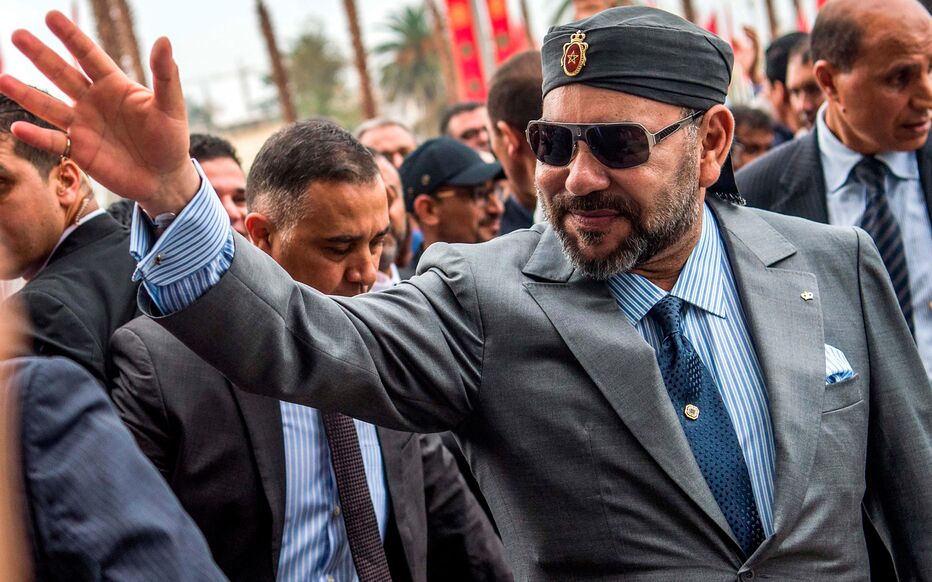
King Mohammed VI did not come to an empty throne; he is the heir to a tradition that spans thousands of years, with a proven ability to adapt to internal and external transformations. Since his accession to the throne, he has adopted a model that combines the symbolism of national unity with real executive power: constitutional reforms, major development projects, and social and economic policies aimed at modernizing the state without compromising its historical stability. This approach can only be understood within the framework of the continuity of an ancient institution, not as mere individual steps by a modern head of state.
The monarchy’s strategic capability is also evident in its management of international relations. Morocco has maintained clear political independence in a turbulent regional environment and has strengthened its regional and international position through active diplomacy and well-thought-out alliances, surpassing any narrow expectations about the monarchy’s “lack of influence.” Massive, transcontinental projects, such as energy lines and strategic infrastructure, or the strengthening of alliances with major international powers, are not just economic decisions, but sovereign signals that confirm Morocco no longer accepts a subservient role.
On the domestic level, the monarchy has managed to maintain a delicate balance between centralization and decentralization, between symbolic and executive power, and between tradition and modernity. This institutional flexibility gives Morocco an exceptional strength compared to other countries in the region, where institutions crumble under political and social pressures.
In short, what outsiders sometimes see as “an enigma” or “hesitation” is in fact a precise strategy: a historical continuity in which experience is blended with a bet on modernity, ensuring the state’s stability and strengthening its regional position, without abandoning the symbolism of the throne that remains the guarantor of unity and sovereignty.
The monarchy’s function as a unifying element and a guarantor of stability is not just a relic of the past, but a living reality that explains the “Moroccan exception” today. In a turbulent regional environment, Morocco stands as a model of institutional stability, a result of the existence of an institution with deep legitimacy that transcends partisan and ideological divisions and acts as a supreme reference for the state and society. The ancient function of the Agellid, who united tribes to face dangers, is manifested today in the monarchy’s ability to lead the state through major transformations and maintain its internal cohesion.
This internal stability enables Morocco to pursue an independent and confident foreign policy, which seems to concern some Western circles. What the Western press calls the “Mohammed VI enigma” is not a real mystery; the opacity that outsiders see is not weakness or hesitation, but an expression of the confidence of an ancient institution that operates according to the logic of a continuous state, not according to fleeting media reactions. The real Western concern does not stem from an imaginary “end of an era,” but from the beginning of a new and clear one: the era of full Moroccan sovereignty. Perhaps the true “enigma” is not in Rabat, but abroad, where many find it difficult to adapt to the fact that their historical partner has become an independent international actor, drawing its strength from a history that spans thousands of years and a legitimacy rooted in society and history.
Beyond the “Enigma” — The Continuity of Moroccan Sovereignty
What some European newspapers have tried to call the “Mohammed VI enigma” is not a Moroccan mystery, but a reflection of the failure of the European approach to read a political reality rooted in history, and different in its origins and depth from any familiar Western model. Morocco is not a temporary experiment, but the continuation of a sovereign and civilizational tradition thousands of years old, extending from the mythical kings of the Atlas and the Amghar who united the tribes, through kingdoms that exercised real sovereignty, to the modern monarchy that combines the symbolism of unity and executive power. And what is read from the outside as opacity is nothing but a historical wisdom and a deliberate strategy of an institution that has learned how to balance tradition and modernity, and symbolic authority with executive power.
The strength of the Moroccan throne does not lie in its fleeting media presence, but in its ability to transform its legitimacy, rooted in history and national consciousness, into internal stability and effective external sovereignty. From Bocchus I to Mohammed VI, the monarchy’s red line remains the same: to unite the nation, protect it, and lead it toward the future. Morocco, with its ancient civilization and its role as the cradle of rational humanity and a civilizational source of great discoveries, remains a nation with strong roots, a cohesive political entity, and an international actor whose secrets are gradually revealed to the world. Understanding this lineage is the key to understanding the present and the future.